

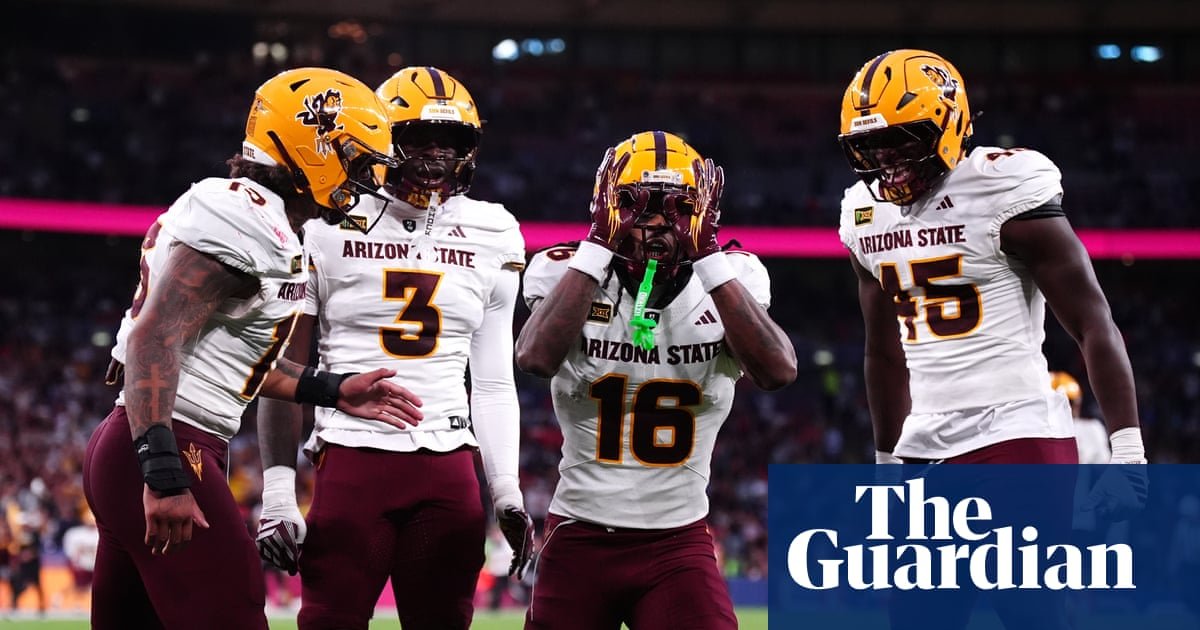
The Arizona State Sun Devils secured a victory in the inaugural Union Jack Classic before a boisterous crowd, even as thousands of seats remained unoccupied.
You could tell that Britain’s first US college football game in nearly four decades would be a unique experience as Wembley Way began to hum with the sound of physical intensity and cheering long before the opening kick-off.
The energy originated from the Arizona State Sun Devils’ marching band, whose members were so spirited that their horns and trombones swayed back and forth like searchlights scanning the night sky as they performed.
Shortly after, the Kansas Jayhawks’ marching band offered a musical rebuttal, accompanied by further roars from the large gathering outside the stadium.
Nearby, two relaxed police officers were observing the scene when they were approached by a fan, Ian Taplin, from Milton Keynes. “I bet you’re glad you are not at Millwall,” he remarked, prompting both officers to smile.
It was a moment that stood out during a lackluster match that dragged on for three hours and 37 minutes. Even during the slower periods, the marching bands ensured the atmosphere never dipped. The Jayhawks’ band played The Beatles’ “Twist and Shout” and Cameo’s “Word Up,” while the Sun Devils’ band countered with Salt-N-Pepa’s “Push It.” It created a truly distinct and vibrant environment.
As for the game itself, it is fair to say the Union Jack Classic did not live up to its name. It was hardly a classic. The Arizona State Sun Devils won 24-17, though the scoreline was far less competitive than it suggests. For most of the game, the Jayhawks’ offense was as uninspired and heavy as suet pudding.
Before the match, Fox Sports analyst Chris Fallica suggested that this contest was comparable to a lower-tier Premier League or upper-tier Championship fixture, likening it to Nottingham Forest versus Coventry. He proved to be correct.
Little of note occurred until the game shifted decisively in the minute surrounding half-time. At that stage, Kansas held a 7-3 lead in a dull affair, following a 72-yard punt return from Taty Nagy. Then, everything changed.
First, the Jayhawks’ punter Matthew Gill shanked a kick for only 17 yards. On the ensuing play, ASU quarterback Cutter Boley connected with Reed Harris for a 25-yard touchdown to take a 10-7 lead.
Then, adding insult to injury, Jaren Hamilton dropped a shoulder, shook off a tackle, and sprinted for a 100-yard kick-off return to extend the lead to 17-7. “I had a feeling deep in my soul,” said the man they call Turbo. “I knew something was going to happen.”
The contest was effectively decided when 305lb conference hopes will be a significant brand-building exercise in Europe.
“These schools are obviously getting rewarded financially to come over,” Fallica told the Guardian. “But it’s also about exposure. All these schools have international branches. They want international students to come over. So they are getting their brand out there.”
That objective was evident during the game’s first timeout, as advertisements highlighting ASU’s new London Campus and its promise of an “education unlike anything in the UK” were broadcast on the stadium screens.
Brett Yormack, the commissioner of the Big 12, stated that they aim to emulate the NFL by hosting more games in Europe, adding that he hopes to announce next year’s Wembley fixture soon. “We’re not there yet, but I’m confident we’ll be back,” he said. “It’s been fantastic.”
That sentiment was echoed by ASU coach Kenny Dillingham, who described the London trip as a life-changing experience.
“We’ve had multiple players saying: ‘Man, I want to come back now. I love this place. London is awesome. I want to come back and spend summer or Christmas out here’.
“When they asked me to do this game I said there’s a few things that are just mandatory for me. We’re bringing all 105 players. And our families are going to have a once in a lifetime experience. And our team didn’t flinch. They stepped up, they covered the cost, and they made it an experience that I think everybody and every family member, every player will remember for the rest of their life.”
His team clearly embraced the London experience. Whether that enthusiasm is shared by the British public toward college football remains an open question.
